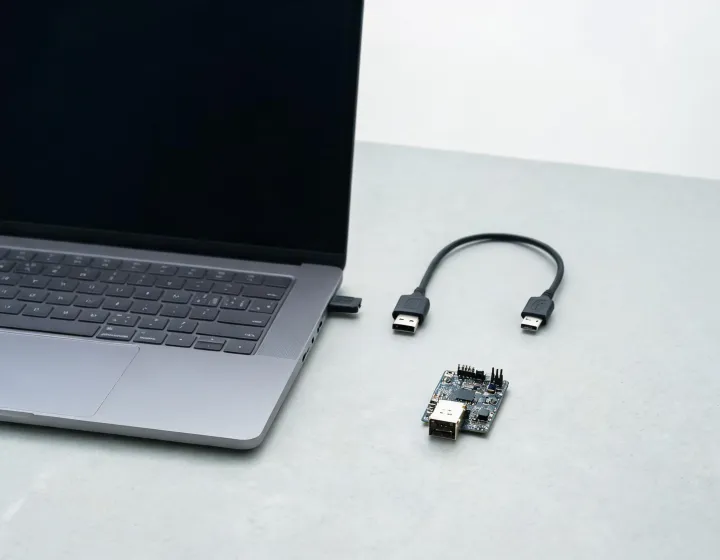
Laptop beside a small unbranded USB signal-generator module and a USB cable

Host compatibility split

usb programmable signal generator price

A usb programmable signal generator price is a host-plus-module figure until someone lists the computer, the driver, the command set, and the accessories that leave the box. LinkScope Sourcing 55 coordinates that list with factories. The desk is an independent sourcing partner and does not ship modules from this page.

Start with the controlling machine: operating system, USB port type, and whether a vendor driver or a plain SCPI session is required. Then write frequency range, level in dBm, channel count, and whether the module must lock to an external 10 MHz reference. Impedance and connector still matter on a small brick. A 50 ohm SMA output is a different fixture mate from an adapter chain someone adds later.

Power input may be the USB bus or a separate supply. Say which one the bench can provide. Environment is usually a lab bench, but a production rack changes cooling and cable strain. Quantity and the US destination decide freight. Requested timing should be a date or a week count, not the word soon. A host row that separates unlike modules is Windows 11, USB 2.0, SCPI, 9 kHz to 6 GHz, -120 dBm to +10 dBm, 50 ohm SMA, lock to 10 MHz, harmonics -30 dBc at 1 GHz, and VSWR 1.8:1 at 3 GHz. A 3 GHz brick at +7 dBm with no reference input stays on its own row. Background is a production PC that already exists. Process is to price the module, the reference lead, and the host as separate cells. Result is two totals instead of one blended usb programmable signal generator price. Measurement accuracy still needs the datasheet condition, and calibration traceability still needs the certificate date.
What each supplier must price

Use the same exclusions on every reply so a usb programmable signal generator price can be normalized. Missing lines are open questions, not silent inclusions.

Inside the instrument line

Exact manufacturer, model, and options. Frequency range with units. Output level range in dBm. Modulation, if any, and the license that enables it. Connector, impedance, and channel count. Display or logging, even if the display is the host screen.

Beside the instrument line

Calibration evidence: certificate date, parameters, and whether a fresh calibration is included. Probe or accessory scope: cables, adapters, and a reference clock lead. Software media or a download entitlement. Freight, duties, and the Incoterm the supplier is using.

Commercial basis

Currency, quantity, and whether the number is per unit or the whole order. Lead time counted from order, from export paperwork, or from calibration completion. Warranty months and who performs repair. A target budget can sit next to this basis. It is not a price the desk has already obtained.

Exclusions to force into writing

Host computer, if the buyer already owns it. Import brokerage. On-site commissioning. A second calibration after transit. Waveform packs that are optional. If the supplier prefers a high-end, mid-range, or budget build, record that as the buyer preference you stated, not as a verified rank.

Open the inquiry names if you still need to pick the family label before this checklist is sent.

Evidence the quote should carry

Which file ties the module to a host?

Ask for the driver or SCPI manual revision that matches the firmware on the quoted serial family. A marketing note that says programmable is weaker than a command list and a stated operating system. IEEE 802 may describe the office network around the host PC. It does not describe the RF output.

Which calibration lines belong on the paper?

Frequency, level, and, when used, modulation fidelity. Measurement accuracy should name the tolerance and the condition, for example level within a stated dB window at a stated frequency. Calibration traceability is the chain on the certificate, not a logo in the footer of a brochure.

What changes the figure after the headline?

Adapters, a torque-limited cable, an external reference, and a recalibration before shipment each move cost. Harmonic level in dBc and VSWR, if the fixture is sensitive, should be requested at the upper frequency the buyer named, with the datasheet revision attached.

When is a lower-band module not an alternate?

If the procedure states 6 GHz and the offer stops at 3 GHz in fundamental mode, the offer is a deviation. The supplier should label it as a deviation rather than fold it into the same price column. Accepting it is a buyer decision after the missing band is visible.

Review the USB scope, then send it

The form sits on the left of this band, opposite the home page arrangement, and the panel stays on the pale green field. Put host, frequency, level, quantity, destination, and timing in the requirement box.

Comparison habit

Lay replies in one sheet: model, options, frequency range, connector, calibration date, software, freight, and exclusions. Do not average unlike scopes into one number. A whole-order budget and a per-unit budget answer different questions, so keep the basis in the row header.

New equipment and refurbished equipment need separate rows. Refurbished can be appropriate when the option set matches the old procedure and the calibration date is current enough for the quality plan. Condition, missing keys, and cosmetic notes stay on that row. The requirement desk is the place to send the sheet.