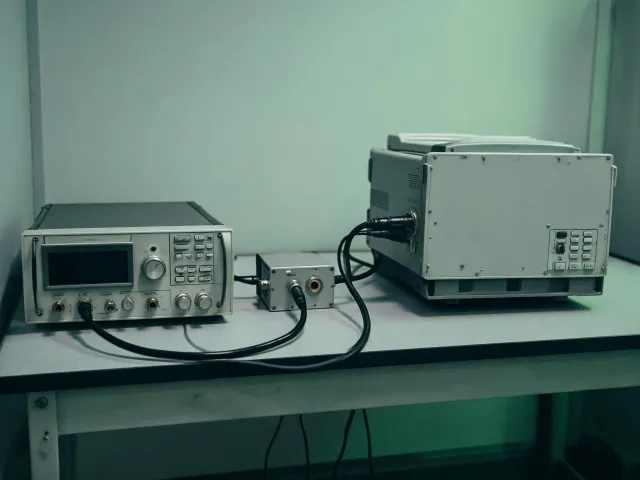
An 18 ghz signal generator brief starts from the project, not from a catalog photo. LinkScope Sourcing 55 helps a buyer translate that project into purchase fields and then request factory quotes. The desk does not operate the bench and does not claim the source is already matched to a fixture.
Write the intended use in one sentence: stimulus for a conducted measurement to 18 GHz, a local oscillator substitute, or a checkout tone for a microwave path. Record the host, if a controller is involved, the topology of the coax path, and the interface at the instrument. Frequency range must say whether 18 GHz is required at the instrument connector as a fundamental output. A lower-band source plus a multiplier can reach a similar number and still change harmonics, conversion loss, and the connector on the head.
Power rating here means output level in dBm at the frequency the project uses, plus the AC mains or USB power the chassis draws. Environment covers bench temperature and whether the unit sits in a rack. Quantity, destination, and the delivery stage (instrument arrival, calibration complete, or fixture sign-off) should be separate dates.
SMA, N, and 2.92 mm are not interchangeable at 18 GHz without an adapter note. Ask which connector is on the quoted output and whether adapters are included. VSWR and impedance (commonly 50 ohm) should be requested at the upper frequency, with the datasheet revision named.
Harmonics in dBc decide whether a multiplier path is acceptable. Request the specification at the frequency the project cares about, and ask if the number is typical or a datasheet maximum. This page does not publish a limit of its own.
Measurement accuracy for amplitude is a tolerance in dB under a stated condition. Frequency accuracy is a different line. If the project uses a narrow receiver, both lines matter. Calibration traceability attaches those lines to a certificate for the serial number, not to the product family.
Ask for the current datasheet, the option list, the power-input rating, and any applicable equipment-authorization evidence for the exact model. Site constraints include rack unit height, mains voltage, and whether an external reference is available. FCC equipment-authorization rules are a question source for the exact model. They are not a certificate hosted here.
Two sourcing paths show up on 18 GHz benches. The table is a selection guide. It does not name a winner and it does not copy another seller inventory.
| Path | What to write | What can go wrong if omitted |
|---|---|---|
| Native output through 18 GHz | Fundamental range, connector, level in dBm at 18 GHz, harmonic spec in dBc | A brochure range may be a harmonic mode with a different level |
| Lower-band source plus multiplier | Base range, multiplier band, head connector, conversion loss, whether the head is in the price | The instrument price looks complete while the head is an extra line |
| New instrument | Option licenses, firmware, calibration date near shipment, warranty party | A missing vector or pulse option surfaces after the procedure is loaded |
| Refurbished instrument | Condition, remaining options, calibration due date, support route | A discontinued chassis can fit a legacy procedure and still lack a key |
New equipment can make option licenses and a recent calibration easier to read. Refurbished equipment can cover a discontinued configuration when condition and entitlement are written down. Neither path is assumed correct for every lab. The buyer marks which path is acceptable.
Vector modulation is a separate fork from a CW 18 GHz tone. If the project is a single tone, do not force an I/Q license into the mandatory column. If the project needs a modulated carrier, a CW-capable microwave source is a deviation, even when the frequency number matches. Analog CW and vector I/Q should be two quote columns.
Background: a US fixture group needs two sources that present 18 GHz at a 2.92 mm connector, quantity 2, destination a Texas lab, requested timing ten weeks, budget still undecided and marked per unit in USD once finance replies. Process: the brief splits native 18 GHz chassis from a 6 GHz source plus a multiplier head, and it asks each factory for harmonic level, level flatness, calibration date, and whether adapters are included. Result: the replies can be compared on connector, frequency basis, and delivered scope. No percentage saving is calculated on this site because no controlled quote set is published here.
The dark band names the request. The white card under the heading holds the same form used in the dialog, with room for frequency, connector, quantity, destination, and timing.
Qualified briefs can include sourcing support of up to 3%.
Eligibility applies to qualified business buyers and is confirmed after we review your product, quantity, destination, and sourcing requirements.
Prepare a Telecom RFQ